
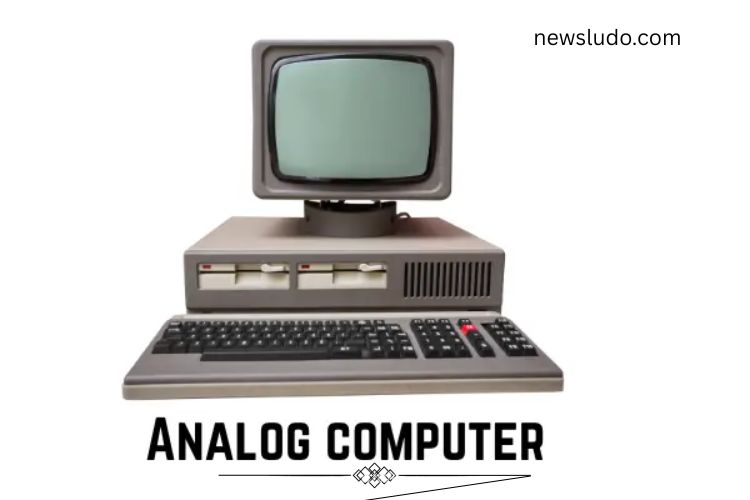
Understanding computers today often focuses on digital devices, but analog computers have played a crucial role in history and specialized fields. If you’ve ever wondered how these unique machines work, this guide will explain everything—from their basics to their types, components, examples, and real-world applications.
Read More: https://newsludo.com/inspiring-examples-of-web-applications/
What Is an Analog Computer?
An analog computer is a machine that processes information using continuous signals rather than discrete numbers. It measures physical quantities such as voltage, mechanical movement, or fluid pressure to solve problems. Unlike digital computers, which rely on binary code, analog computers handle real-world, smoothly changing data directly. They were essential for scientific calculations before digital computers became mainstream and are still used today for specific applications requiring real-time simulation or modeling.
A Brief History of Analog Computers
Analog computers have existed for centuries. One of the earliest examples is the Antikythera Mechanism, an ancient Greek device used to predict astronomical events like eclipses and planetary movements.
In the 19th century, William Thomson developed machines to predict tides. The early 20th century saw mechanical devices with gears and wheels capable of solving complex mathematical problems faster than human computation.
By the 1930s, Vannevar Bush built the differential analyzer, a significant mechanical analog computer. During World War II, analog computers were used in submarines, aircraft guidance systems, and even in economic modeling, such as the MONIAC machine, which used water to simulate national economies.
As digital computers became more accurate and easier to use, analog systems became less common. However, they remain valuable in areas where continuous simulation is critical.
Examples of Analog Computers

Analog computers come in many forms, from simple mechanical devices to sophisticated electronic systems. Some well-known examples include:
- Slide Rule: Solves math problems using sliding scales.
- Planimeter: Measures areas on maps and drawings.
- Nomogram: Provides solutions visually through plotted lines.
- Antikythera Mechanism: Predicts celestial movements.
- Differential Analyzer: Uses gears to solve complex equations.
- Water Integrator: Uses flowing water to model mathematical equations.
- Reeves Electronic Analog Computer (REAC): Models systems via electronic circuits.
- AKAT-1: Simulates control systems electronically.
- Astrolabe: Tracks stars and planets.
- Kerrison Predictor & Norden Bombsight: Aid in military targeting and navigation.
- MONIAC: Models economies using water tanks.
- Analog Oscilloscope & Sound Processors: Visualize waveforms and audio signals.
These examples highlight the diversity and adaptability of analog computing systems across different domains.
Key Components of an Analog Computer
Analog computers use specialized components to process continuous data. Each part contributes to computation:
- Input Devices: Collect signals from the environment.
- Amplifiers: Boost signal strength.
- Integrators: Perform cumulative addition over time.
- Differentiators: Measure rates of change.
- Adders and Multipliers: Combine or multiply signals for calculations.
- Function Generators: Produce specific waveform outputs.
- Output Devices: Display results on meters, screens, or plots.
- Control Panel: Allows users to configure the system for specific tasks.
These components work together to perform calculations directly on real-world physical quantities.
How Analog Computers Work
Analog computers operate using continuous physical signals rather than discrete numerical data. Their working process includes:
- Signal Generation: Input sources create voltages, currents, or other signals.
- Signal Reception: Input devices capture these signals.
- Amplification: Signals are strengthened for processing.
- Processing: Components like integrators, differentiators, adders, and multipliers perform calculations.
- Function Generation: Special waveforms are created if needed.
- Output Display: Results appear on meters, screens, or plots.
- Control and Adjustment: Users configure the system through the control panel for accurate results.
This step-by-step approach allows analog computers to simulate complex real-world systems in real time.
Types of Analog Computers
Analog computers vary based on their working principle:
- Mechanical Analog Computers: Use gears, levers, and wheels for calculations.
- Electrical Analog Computers: Rely on electrical circuits and signals.
- Hydraulic Analog Computers: Use water flow and pressure to model systems.
- Pneumatic Analog Computers: Utilize air pressure for computation.
- Electronic Analog Computers: Employ amplifiers and electronic circuits for advanced simulation.
Each type has unique advantages for solving specific kinds of problems.
Applications of Analog Computers
Despite being largely replaced by digital computers, analog systems excel in applications involving continuous data and real-time modeling:
- Weather Prediction: Simulate changing atmospheric conditions for accurate forecasts.
- Flight Simulation: Train pilots by replicating aircraft controls and dynamics.
- Tidal Prediction: Forecast tides for navigation and fishing.
- Economic Modeling: Study trends by simulating national economies.
- Military Systems: Guide missiles, bombs, and control defense systems.
- Engineering Design: Test mechanical or electrical systems before production.
- Medical Devices: Monitor and process patient signals in real time.
Analog computers are especially valuable when simulations must respond instantly to continuously changing data.
Advantages of Analog Computers
Analog computers offer several benefits:
- Fast problem-solving with real-time results.
- Effective handling of continuous data.
- Direct simulation of physical systems.
- Simple hardware design with less energy consumption for certain tasks.
- Immediate visualization of outputs.
- Minimal programming effort required.
- Robust performance with noisy or fluctuating data.
Limitations of Analog Computers
However, analog systems also face challenges:
- Less precise than digital counterparts.
- Limited data storage and memory.
- Complex tasks can be difficult to implement.
- Sensitive to noise, mechanical wear, and calibration errors.
- Restricted flexibility in programming.
- Cannot retain long-term data reliably.
- Low repeatability for identical results.
These limitations explain why digital computers have largely taken over general-purpose computing.
Analog vs Digital Computers
While digital computers dominate everyday use due to accuracy, storage, and programming ease, analog computers remain unmatched in specific areas requiring real-time continuous simulation. Their ability to model physical systems and handle noisy data in real time keeps them relevant in specialized engineering, scientific, and military applications.
Frequently Asked Questions:
What is an analog computer?
An analog computer is a type of machine that processes information using continuous signals rather than discrete numbers. It works with physical quantities like voltage, mechanical movement, or water flow to solve real-world problems in real time.
How does an analog computer differ from a digital computer?
Digital computers use binary code (0s and 1s) to process data, while analog computers measure and manipulate continuous signals. Analog computers are better for real-time simulation and continuous data, whereas digital computers excel in accuracy, storage, and complex tasks.
Why are analog computers still relevant?
Analog computers remain important in specialized fields where real-time simulation and continuous data modeling are critical. Their ability to simulate physical processes quickly and efficiently keeps them relevant in science, engineering, and military applications.
How does an analog computer solve problems?
Analog computers process continuous signals using components like integrators, differentiators, adders, and multipliers. These parts manipulate real-world quantities (voltage, mechanical motion, or fluid flow) to produce real-time results.
Can analog computers store data?
Analog computers have very limited data storage. They process information in real time but cannot retain large amounts of data like digital computers.
Are analog computers accurate?
They are less precise than digital computers because they rely on continuous signals that can be affected by noise, drift, or mechanical errors. However, they are sufficient for many simulations and real-time applications.
Can analog computers perform complex calculations?
Yes, but with limitations. Mechanical and early electronic analog computers can solve complex differential equations and simulate physical systems, but digital computers are better for large-scale or highly precise computations.
Were analog computers used in wars?
Yes. During World War II, analog computers guided submarines, aircraft, and artillery. Devices like the Kerrison Predictor and Norden Bombsight were essential for targeting and navigation.
Conclusion
Analog computers may seem like a relic of the past, but they remain a fascinating and important part of computing history. By using continuous signals to process real-world data, they provided fast, efficient solutions for complex problems long before digital computers dominated. From predicting tides and modeling economies to guiding aircraft and simulating engineering systems, analog computers demonstrated the power of real-time computation.