Computers have evolved in countless ways, from simple desktops to the most advanced systems in the world. Among these, mainframes and supercomputers stand out as powerful machines designed for very specific purposes. Although both are exceptional in performance, they serve different roles, operate at different speeds, and handle data in unique ways. Understanding the differences between mainframes and supercomputers is essential for businesses, scientists, and technology enthusiasts alike.
Read More: https://newsludo.com/unlocking-the-power-of-workstation-computers/
Purpose of Use
Mainframes and supercomputers are designed with distinct goals in mind.
Mainframe:
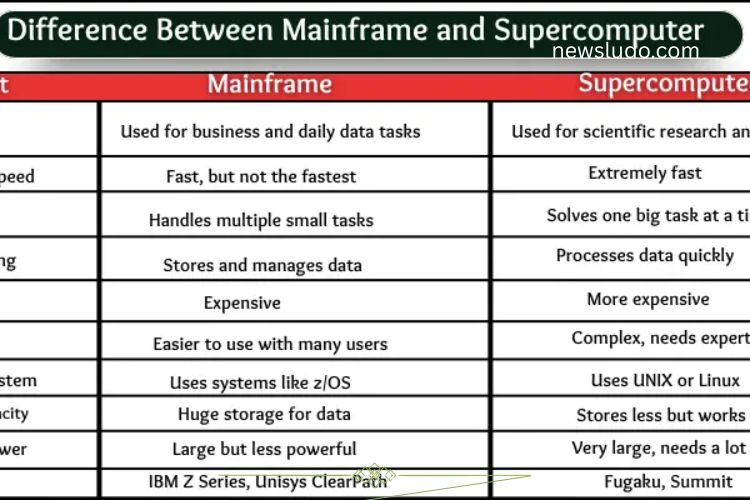
Mainframe computers are the backbone of large organizations. They are built to store and manage massive volumes of data while supporting thousands of users simultaneously. Industries such as banking, healthcare, airlines, and government offices rely on mainframes daily to process transactions, manage records, and maintain continuous operations. Their primary focus is on reliability, stability, and multitasking.
Supercomputer:
Supercomputers, on the other hand, are built for solving highly complex problems at unprecedented speeds. These systems are predominantly used in research and scientific fields. Applications include climate modeling, space exploration, molecular biology, and artificial intelligence simulations. Unlike mainframes, supercomputers are not designed for general business use and are typically inaccessible to regular offices or individual users.
Processing Speed
Speed is one of the most obvious differences between mainframes and supercomputers.
Mainframe:
Mainframes offer fast performance and can execute numerous operations simultaneously. They are optimized for multitasking, allowing multiple users and applications to run without slowing down. However, while fast, mainframes are not designed to perform the extreme calculations that supercomputers handle.
Supercomputer:
Supercomputers are in a league of their own when it comes to processing speed. These machines can perform trillions of calculations per second, enabling researchers to solve massive computational problems in seconds. Their primary goal is raw speed, which is crucial for scientific simulations and complex modeling.
Task Type
The tasks performed by mainframes and supercomputers differ fundamentally.
Mainframe:
Mainframes excel at managing numerous smaller tasks simultaneously. They handle repetitive, structured operations such as processing financial transactions, maintaining records, and running enterprise applications. Their design prioritizes stability and consistent performance over solving complex mathematical problems.
Supercomputer:
Supercomputers focus on single, high-intensity tasks. They are designed to tackle extremely challenging problems that require immense computational power, such as weather forecasting, nuclear simulations, or analyzing astronomical data. Supercomputers prioritize speed and accuracy for specialized scientific applications.
Data Handling
Both systems manage data, but the approach varies based on their purpose.
Mainframe:
Mainframes manage vast amounts of transactional and operational data. They store customer records, employee information, financial data, and other critical files. The emphasis is on reliability, data integrity, and accessibility for multiple users at once.
Supercomputer:
Supercomputers use data primarily for calculations and simulations. While they handle large datasets, their goal is to process information rapidly and generate results for scientific and research purposes. Unlike mainframes, storage capacity is secondary to processing speed.
Cost
Cost is a key consideration when comparing these two types of computers.
Mainframe:
Mainframes are expensive but affordable for large enterprises. They require substantial investment in hardware, software, and maintenance, but they are cost-effective for companies that need to manage large-scale operations efficiently.
Supercomputer:
Supercomputers are far more expensive than mainframes. Their specialized hardware, immense processing power, and energy requirements make them accessible only to research institutions, governments, and large tech companies. For most businesses, owning a supercomputer is impractical.
Complexity
The complexity of operation differs significantly between mainframes and supercomputers.
Mainframe:
Mainframes are complex but manageable for IT teams. They allow multiple users to perform routine tasks without extensive technical knowledge. Their user-friendly design ensures that daily operations run smoothly, even in massive organizations.
Supercomputer:
Supercomputers are highly complex and require expert knowledge to operate. They consist of specialized components and software that demand skilled personnel. Only trained scientists and engineers can configure, operate, and maintain these machines effectively.
Operating System
The operating systems used by mainframes and supercomputers reflect their specific requirements.
Mainframe:
Mainframes use operating systems like z/OS or OS/390. These systems manage multiple users and tasks efficiently, ensuring high reliability for corporate operations. Security, data integrity, and multitasking are core priorities.
Supercomputer:
Supercomputers typically use UNIX or Linux-based operating systems optimized for speed and high-performance computing. These systems provide the flexibility and power required for solving scientific and research problems rapidly.
Storage Capacity
While both systems handle large amounts of data, storage strategies differ.
Mainframe:
Mainframes are built to store enormous amounts of data reliably. This is essential for industries that maintain detailed records over long periods, such as banks or hospitals. Their storage systems are designed for durability and accessibility.
Supercomputer:
Supercomputers focus on processing speed rather than raw storage capacity. They manage data in ways that allow rapid access during computations. While they can handle large datasets, storage is optimized to support performance-intensive tasks.
Size and Power
The physical size and power requirements of mainframes and supercomputers highlight their differences.
Mainframe:
Mainframes are large machines, often the size of a room or a sizable cabinet. They require significant power but are smaller and less demanding than supercomputers. They are powerful enough to handle multiple operations for thousands of users concurrently.
Supercomputer:
Supercomputers are enormous and can occupy entire buildings. They require massive amounts of electricity and cooling systems to operate. Their immense power allows them to perform calculations at speeds far beyond any other type of computer.
Frequently Asked Question:
What is the main difference between a mainframe and a supercomputer?
Mainframes are designed to handle large amounts of data for many users at the same time, making them ideal for businesses and institutions. Supercomputers focus on solving extremely complex problems at incredible speeds, mainly used in scientific research.
Which one is faster, a mainframe or a supercomputer?
Supercomputers are significantly faster. They perform trillions of calculations per second to solve complex problems, while mainframes are optimized for multitasking rather than raw speed.
What tasks are mainframes used for?
Mainframes manage daily operations in banks, hospitals, airlines, and government offices. They process transactions, store records, and run enterprise applications efficiently for multiple users.
What tasks are supercomputers used for?
Supercomputers handle research and scientific tasks that require massive computational power. Examples include climate modeling, space simulations, genetic research, and artificial intelligence.
Are mainframes or supercomputers more expensive?
Supercomputers are generally more expensive due to their specialized hardware and extreme processing capabilities. Mainframes are costly too but are more affordable for large organizations.
How complex is it to operate each system?
Mainframes are easier to operate and maintain, designed for multiple users performing everyday tasks. Supercomputers require expert knowledge and specialized teams to manage, as they handle complex calculations.
Which operating systems do they use?
Mainframes typically run on z/OS or OS/390 to manage multiple users and tasks. Supercomputers often use UNIX or Linux-based systems optimized for high-speed computations.
Conclusion
Mainframes and supercomputers represent two pinnacle achievements in computing, each designed to excel in its own domain. Mainframes provide reliable, large-scale data management for businesses and institutions, ensuring smooth operations for thousands of users simultaneously. Supercomputers, in contrast, push the boundaries of speed and computational power, enabling scientists and researchers to tackle the world’s most complex problems. While mainframes prioritize multitasking, stability, and data integrity, supercomputers focus on raw speed, precision, and high-performance problem-solving. Understanding their differences helps organizations choose the right system for their needs, whether it’s managing critical operations or advancing scientific discovery.